Zero Returned
What Decimal Notation suggests about Repetition, Identity, and Infinity
April 29, 2026
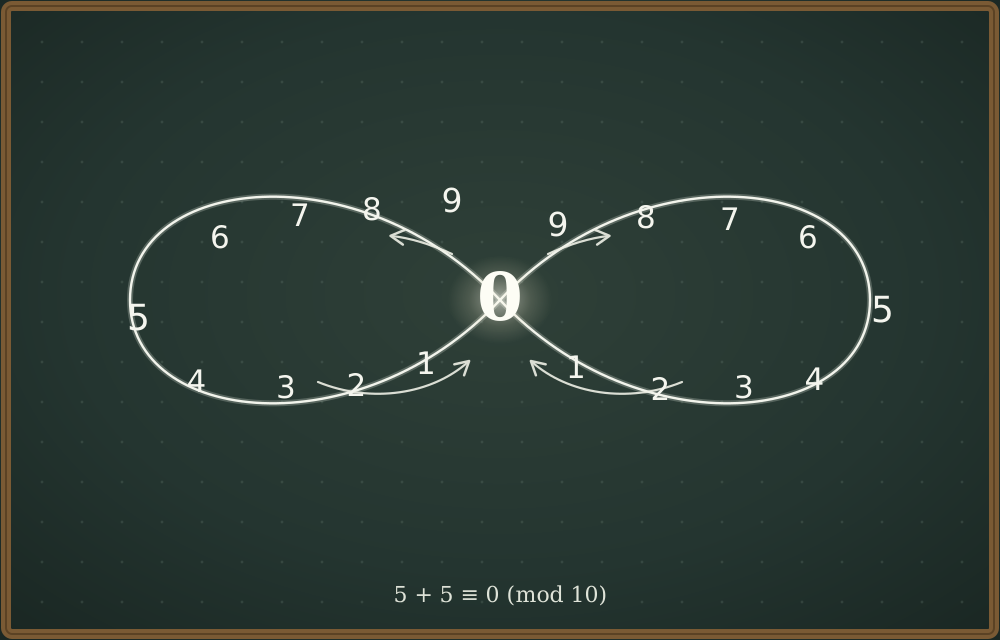
5 + 5 ≡ 0 (mod 10)
Table of Contents
- Abstract
- I. The Arrow and its Assumption
- II. The Crossing Point
- III. The Aphelion at Five
- IV. Infinite as Frequency
- V. Objections and Limits
- VI. What the Sketch Already Knew
- References
Abstract
Human counting unconsciously encodes two intuitions at once. The first is linear: quantity increases without bound, each number succeeding the last, the count extending forever into a horizon that never closes. The second is cyclical: the symbols that carry the count return, decade after decade, scale after scale, in an unbroken pattern of recurrence that no amount of accumulation ever disrupts. These two intuitions have always coexisted within the decimal system. They have rarely been examined together.
This essay is that examination.
The duality embedded in decimal notation mirrors enduring metaphysical tensions that run through philosophy, theology, and the sciences: progress and return, becoming and identity, horizon and center, the one and the many. Numeral systems are not arbitrary. They preserve deep cognitive intuitions about how reality is structured — about accumulation and reset, order and recurrence, the boundary and the center. To read those intuitions carefully is not to do mathematics. It is to do metaphysics.
What follows is a metaphysical meditation on recurrence embedded in number representation. It does not challenge the formal structure of arithmetic. It does not propose a new foundation for mathematics. It proposes something more modest and, I believe, more interesting: that the decimal number line contains a geometry it has never been asked to show, and that when it is asked, what appears is the lemniscate — the figure-eight curve of infinite crossings within a bounded space, the shape of endless return.
The digits do not depart. They return. And each return is higher than the last.
I. The Arrow and its Assumption
Pick up any mathematics textbook written for children and turn to the chapter on numbers. You will find, within the first few pages, a drawing that has become so universal it is no longer recognized as a choice. It is a horizontal line, extending in both directions, with an arrow at each end. Numbers are placed along it at regular intervals — negative to the left, positive to the right — and the arrows say, without ambiguity: this continues forever. There is no edge. There is no return.
This image is called the number line. It is one of the most successful pedagogical tools in the history of human education. It captures one truth about number with complete accuracy: value increases without bound. The arrow is honest about quantity.
But the arrow also implies, without stating it, a particular metaphysics of infinity. That to count is to travel away. That each number is simply a new place, further from the origin than the last. That infinity is the ultimate departure — perpetual extension into an unreachable beyond with no structural return. This is not a mathematical claim. It is a picture. And pictures carry assumptions.
The assumption worth examining is not the arithmetic. It is the geometry — specifically, the geometry of form rather than value. When you look not at how much the numbers accumulate but at the symbols that represent them within decimal notation, something entirely different appears.
The value increases without limit. The form recurs without exception. These are not the same statement.
Zero appears at the origin. Then again at ten. Then again at twenty, thirty, forty — at every decade boundary, without exception, without end. Five appears at the midpoint of every decade — at 5, at 15, at 55, at 500,005 — always equidistant from the zero behind and the zero ahead. The digits 1 through 9 trace the same sequence in every decade, at every order of magnitude, from the smallest number a child first learns to the largest a cosmologist can name. The decimal system encodes two things simultaneously: unbounded departure in value, and perfect recurrence in form. The number line shows only the first.
II. The Crossing Point
From zero, the decimal count moves outward. One, two, three, four — each step increasing in value. At five, something changes. Not in the arithmetic — the succession continues without interruption — but in the geometry of the form. Five is the furthest point from zero in the decade. It is the aphelion — the moment of maximum separation before the curve begins its return. Six, seven, eight, nine — the digits are now moving back toward the crossing. And at ten, zero appears again.
Not the same zero. And yet — zero.
This is the moment the number line conceals and the lemniscate reveals. The zero at ten is not a reset that forgets what has been traversed. It is a crossing point — where the curve of the first decade completes itself and the curve of the second begins. It carries within it the entire completed loop. It arrives at the same symbol as the origin but is not the origin. It is the origin elevated by everything counted before it.
This is the first deep metaphysical tension encoded in decimal notation: the question of identity across return. The zero at ten wears the face of the zero at origin. Are they the same? In value, no — one is nothing counted, the other is a completed decade. In symbol, yes — they share the same character, the same shape, the same written form. Decimal notation holds these two answers simultaneously, neither resolving the tension nor acknowledging it. The lemniscate names what is happening: same coordinate, different traversal. Identity that carries accumulation within it.
Same symbol. Incomparably different content.
This is what place value means, understood ontologically. The position of the zero is a record of completed traversals. Each zero to the left of a digit is a loop finished and crossed. The number 1,000,000 does not simply denote a very large quantity. It encodes six completed crossings — six full returns of the decimal loop — each zero marking a traversal that carries within it all the loops that preceded it. The accumulation is not only in the value. It is in the zero itself, which arrives at each crossing enriched by everything that has passed through it.
Center and boundary. Accumulation and reset. One and many. These are not abstract philosophical categories. They are the structure of every number you have ever written.
III. The Aphelion at Five
The role of five as the midpoint of every decade is not arbitrary, and within the decimal system it can be demonstrated with algebraic precision. In modulo ten arithmetic — the formal structure governing digit behavior within decimal notation — five is its own mirror.
\[5 + 5 \equiv 0 \pmod{10}\]Five is the only non-zero digit in the decimal system that, added to itself, returns directly to the crossing point. It is, in the precise algebraic sense, the furthest you can travel from zero before the geometry of the system begins pulling you back. Six is four steps from the next crossing. Seven is three. Eight is two. Nine is one. Five is equidistant — the exact midpoint between the zero behind and the zero ahead, the moment of maximum tension before the return takes over.
In orbital mechanics, the aphelion is the point in a planet’s elliptical path where it is furthest from the sun — where gravitational pull is weakest, outward momentum greatest, and the curve begins its long arc back toward the center. Five occupies exactly that position in every decade of the decimal system. The moment five is passed, the count is already coming home.
The metaphysical intuition encoded here is the intuition of limit — that every outward movement has a structural boundary, a point of maximum extension beyond which return becomes inevitable. The boundary is not imposed from outside. It is internal to the structure. The decimal system does not merely count. It encodes the philosophical conviction that departure and return are not opposites but phases of a single motion.
A departure. A maximum. A return. A crossing. Not a segment of an infinite line. A loop.
IV. Infinity as Frequency
The arrow captures one truth: value increases without bound. There is always a larger integer. In this the standard picture is correct. But within decimal notation, a second truth runs alongside the first — one the arrow does not show.
The form of the digits recurs without exception across every scale the system can reach. The value departs. The structure returns. And the combination of these two facts — unbounded value, recurring form — produces a different understanding of what infinity means within the representational system contemporary society actually uses.
Infinity, read through the lemniscate, is not endless departure. It is unbounded recurrence. It is the capacity of a structure to keep returning, keep crossing, keep beginning again at a higher register, without that process ever exhausting itself or arriving at a final loop. The integers do not march forever rightward into an empty horizon. Within decimal notation, they traverse an endless succession of loops — each loop a decade, each crossing a zero carrying within it everything counted before, each return higher than the last.
Unbounded, yes. Directionless, no. Recurring, always.
Progress and return. Becoming and identity. These are not contradictions that the decimal system fails to resolve. They are tensions it holds simultaneously, in every number ever written, without comment and without collapse. The lemniscate is the shape of that holding.
V. Objections and Limits
A proposition that does not acknowledge its own limits is not a philosophical argument. It is an assertion. The following concessions are made not to weaken the claim but to place it precisely where it can stand.
First: this interpretation depends on decimal notation, not on number in the abstract. The lemniscate geometry described here is a feature of base-ten representation — the system globally dominant in modern civilization, but not the only possible system. In base twelve, the midpoint shifts. In binary, the loop structure changes entirely. The argument concerns the decimal number line specifically — the representational system embedded in every school textbook, every act of everyday counting — not number as a formal object independent of representation. That is a more bounded claim. It is, for that reason, a more defensible one.
Second: the linear order of the integers remains mathematically valid and foundational. Infinite ordered extension is formally coherent and not challenged here. The successor function stands. Cantor’s transfinite hierarchy stands. What is offered is not a replacement for that structure but an additional layer of interpretation — a geometric and ontological reading of what decimal notation does that the linear picture does not make visible.
Third: five as aphelion is a property of modulo ten arithmetic, not a universal feature of number. Its algebraic grounding — 5 + 5 ≡ 0 (mod 10) — is real and rigorous within base ten. It does not generalize beyond that system without modification.
Fourth, and most important: this is interpretive geometry and ontological reading, not replacement arithmetic. The claim is that the decimal system contains a lemniscate structure that has never been named, and that naming it illuminates something about how human beings experience counting, recurrence, and infinity within the system they actually use. A new lens, not a new foundation. Within these limits, the proposition stands.
VI. What the Sketch Already Knew
This proposition did not begin in a mathematics department. It began with a conviction — quiet, persistent, resistant to easy dismissal — that the appearance of endless linear extension conceals a deeper structure of endless return. That the horizon is not the truth of infinity. The crossing point is.
From that conviction came a sketch. Numbers arranged not along a line but along a curve — departing from zero, reaching their furthest point at five, returning through six, seven, eight, nine, crossing again at ten, departing into the next loop. The sketch did not prove anything. It showed something. It made visible a structure that the standard representation keeps invisible by choosing the line over the loop, the arrow over the crossing, departure over return.
This is how genuine philosophical propositions often begin — not with proof but with perception. The perception that something taken as foundational is actually a choice. That a different picture is possible. That the different picture reveals something the standard one was always concealing.
What it conceals is this: within decimal notation, number is not running away from its origin. It is orbiting it. Crossing it. Being elevated by it. The zero is not the absence of number. It is the crossing point that makes the next count possible — the place the curve must return to before it can go further, the symbol that arrives and leaves enriched, again and again, without end.
The cognitive intuitions encoded in the decimal system — center and boundary, accumulation and reset, order and recurrence, the one and the many — are not accidents of notation. The decimal system suggests a mind deeply attuned to cyclical structures in reality. That return is not failure. That the zero you arrive at after traversing a decade is not the zero you left. That identity persists through change, and accumulation passes through the crossing point without erasing it.
The number line gave us the arrow. The lemniscate gives us the crossing. Both are true. Only one has been named.
Infinity is not out there, past the arrow, beyond the last number you can name. It is here: at the crossing point, in the return, in the zero that keeps coming back carrying everything.
Number advances linearly in value, yet decimal notation reveals cyclical returns in form; the lemniscate captures this hidden coexistence of progression and recurrence.
References
- Cantor, Georg. Contributions to the Founding of the Theory of Transfinite Numbers. Dover Publications, 1955.
- Dehaene, Stanislas. The Number Sense. Oxford University Press, 1997.
- Euclid. Elements. Translated by Thomas L. Heath. Dover, 1956.
- Gauss, Carl Friedrich. Disquisitiones Arithmeticae. Yale University Press, 1966.
- Heidegger, Martin. Being and Time. Harper & Row, 1962.
- Husserl, Edmund. Philosophy of Arithmetic. Kluwer, 2003.
Further Reading
Book
-
The Lemniscate of Time: A Geometric Meditation on Eternity and Temporal Succession
ISBN: 9798248842360
Zenodo: DOI: 10.5281/zenodo.18684516
Selected Essays
-
The Lemniscate of Time: A Topology of Memory, Possibility, and Grace
Website: OscarGaitan.org
Zenodo: DOI: 10.5281/zenodo.19121110 -
The Topology of Presence: Four Planes of Existence on the Lemniscate
Website: OscarGaitan.org
Zenodo: DOI: 10.5281/zenodo.19339347 -
Does Time Need Me, or Do I Need Time? The Ontology of the Now, the Invariance of Presence, and the Ground of Being
Website: OscarGaitan.org
Zenodo: DOI: 10.5281/zenodo.19502525 -
The Am that Remains: A Critique of Descartes and a Metaphysics of the Soul
Website: OscarGaitan.org
Zenodo: DOI: 10.5281/zenodo.19842987 -
Alpha and Omega: On the Cosmos, the Now, and the God Who Holds Both Ends
Website: OscarGaitan.org
Zenodo: DOI: 10.5281/zenodo.20112294 -
The Topology of Absolution: Continuity, Agency, and the Non-Replacement of the Self
Website: OscarGaitan.org
Zenodo: DOI: 10.5281/zenodo.20708609 -
The Infinite Interior: On Space, Change, and the Integrity of the Self
Website: OscarGaitan.org
Zenodo: DOI: 10.5281/zenodo.20032817